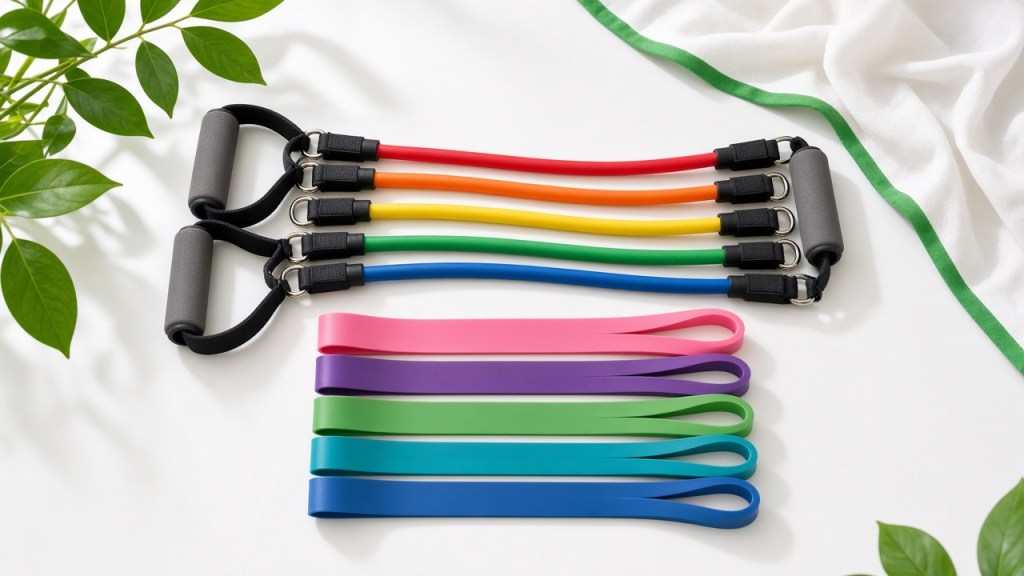
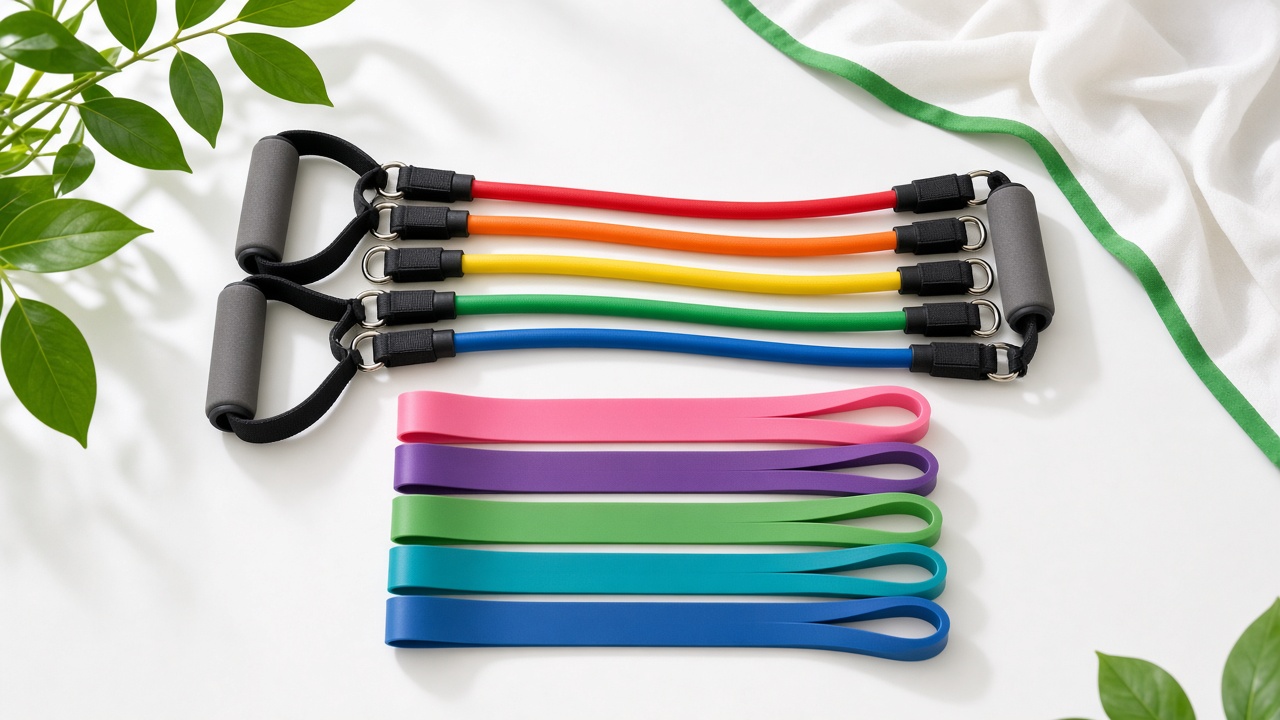
- Best budget: WHATAFIT Resistance Bands with Handles
Resistance bands are one of the easiest ways to add variety to a home routine. They are light, quiet, cheap to store, and they fit in a drawer or a gym bag. The tricky part is that “resistance bands” covers several quite different tools. This guide walks you through the main types, how resistance levels work, what to look for before you buy, and who each type suits best.
A quick word on products: we do not list prices or ratings here, because those change often. Mostly we explain what to look for, and where we name a specific product it is because an independent review recommended it. You can check current details, sizes, and customer reviews directly on Amazon using the links below.
The Four Main Types of Resistance Bands
1. Loop Bands (Long Continuous Loops)
These are long, thick, closed loops of flat latex or fabric-like material. They are versatile: you can loop them around your body for squats and walks, anchor them around a sturdy post for rows and presses, or stand on them for curls.
- Best for: general strength work, stretching, and people who want one band that does many jobs.
- Keep in mind: thicker loops are heavier-duty and can feel stiff at first. Choose a lighter level if you are new.
2. Tube Bands With Handles
These are round, hollow tubes with a handle on each end, often sold with a door anchor and ankle straps. The handles feel familiar if you have used cable machines or dumbbells, which makes them a friendly choice for beginners.
- Best for: upper-body moves like rows, chest presses, shoulder presses, and bicep curls, plus lower-body work with ankle straps.
- Keep in mind: a door anchor needs a sturdy door that closes securely. Check the connection points and clips before every session.
3. Mini Bands (Small Loops)
Mini bands are short, circular bands that sit around your thighs, knees, or ankles. They add gentle challenge to glute bridges, lateral walks, and squats, and they are very popular for warm-ups.
- Best for: lower-body and glute exercises, warm-ups, and travel.
- Keep in mind: fabric versions tend to stay in place better and may feel more comfortable on bare skin than thin latex ones, which can roll.
4. Pull-Up Assist Bands
These are the large, heavy loops used to support some of your bodyweight during pull-ups or chin-ups. You loop one over a pull-up bar and place a knee or foot in the other end. They are also used for stretching and for heavier resistance work.
- Best for: anyone working toward their first pull-up with a sturdy bar.
- Keep in mind: the bar and its mounting must be solid and rated for your weight. Always inspect the band for cracks or thin spots.
Understanding Resistance Levels
Most bands are sold in sets with several levels, usually color-coded. Here is the important part: color codes are not standardized. One company’s “medium” can feel quite different from another’s. So rely on the stated resistance range in the product description rather than the color alone.
- Light: great for warm-ups, shoulder work, and learning form.
- Medium: suits many beginners for rows, squats, and glute work.
- Heavy: useful for larger muscle groups like legs and back once you are comfortable.
- Extra heavy: commonly used for assisted pull-ups or advanced strength moves.
Resistance also increases as a band stretches, and you can change the challenge by shortening the band, stepping farther away from the anchor, or stacking two bands. A set with three to five levels gives you room to grow without buying again.
What to Look For Before You Buy
- Material: natural latex bands are common and stretchy; if you have a latex allergy, look for latex-free options and read the description carefully.
- Stated resistance range: make sure the product lists the resistance of each band, not just colors.
- Thickness and width: wider bands are generally more comfortable against skin; very thin bands may snap or roll.
- Handles and attachments: for tube bands, look for padded handles, secure clips, and a sturdy door anchor.
- Carry bag and guide: a small pouch and a basic exercise chart are nice extras for beginners.
- Safety and durability: check for return policy details, replacement information, and what other buyers say about bands wearing out.
- Set contents: decide whether you want one type or a mixed set so you do not pay for pieces you will not use.
Product specifics such as exact resistance, dimensions, material, and current availability are best checked on the Amazon listing before you buy.
Who Should Choose What?
If you are brand new to exercise
A tube band set with handles or a light-to-medium loop band set is usually the most approachable. Handles feel natural, and loops are flexible enough for many moves.
If you mostly want to train legs and glutes
Mini bands are an easy, inexpensive start. Pair them with a longer loop band if you also want upper-body options.
If you want to build toward pull-ups
Pull-up assist bands combined with a sturdy bar give you a gradual path. Start with a band that makes the movement feel manageable and move to lighter bands over time.
If you travel often
Mini bands and a light tube set take almost no space and weigh very little.
If you have limited space
Any band works well. A single loop band can handle upper body, lower body, and stretching in a small room.
Easy Starter Moves to Try
- Banded squat: place a mini or loop band just above your knees and squat while pressing the knees gently outward.
- Standing row: anchor a tube band at chest height, pull the handles toward your ribs, and squeeze your shoulder blades together.
- Glute bridge with band: keep a mini band above the knees and lift your hips slowly.
- Overhead press: stand on a band and press the handles overhead with control.
Start with two sets of 10 to 12 repetitions, rest between sets, and choose a level that lets you finish with good form.
Bands vs. Other Equipment
Bands are not a replacement for every kind of gear, but they have clear strengths. They take up almost no room, they are generally gentler on your joints than dropping a heavy weight, and they let you change the angle of a movement easily. Free weights feel more predictable because the load stays the same through the whole movement, while bands get harder as they stretch. Many people enjoy using both, for example adjustable dumbbells for big lifts and bands for warm-ups, glute work, and shoulder exercises.
If you are still deciding where to begin, one mixed set of bands is a low-pressure way to try different styles of exercise before committing to anything larger.
Care and Safety Tips
- Inspect bands before each use for nicks, tears, or sticky spots.
- Do not overstretch beyond the manufacturer’s recommended length.
- Avoid anchoring to anything that is not secure.
- Wear closed shoes or sit on a mat when standing on a band.
- Store bands away from direct sunlight and heat, and wipe them clean with a damp cloth.
Final Thoughts
The best resistance band is the one that matches your goals, your space, and your current comfort level. Start with a type that suits how you like to move, check the details on Amazon, and enjoy the variety bands can bring to your home routine.


Leave a Reply